

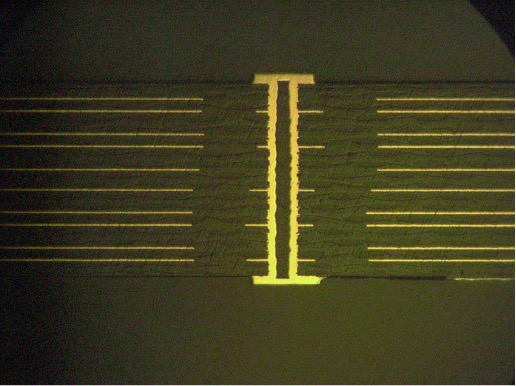
D-coupon testing provides valuable insight into the reliability of plated through-holes, vias, and microvias under thermal stress. By combining thermal cycling, electrical resistance monitoring, and cross-section analysis, D-coupon testing helps identify potential interconnect weaknesses that may not be visible through conventional inspection alone.
For demanding PCB designs, especially multilayer and HDI PCBs, interconnect reliability is critical. A plated structure can meet dimensional requirements during initial inspection while still having a weakness that becomes apparent after exposure to the thermal stresses associated with solder assembly.
For US PCB manufacturing, reliability-focused testing and process controls are important tools for evaluating these critical structures.
What Is D-Coupon Testing?
A D-coupon is a daisy-chained test structure fabricated on the same production panel as the PCB. The coupon contains representative plated interconnect structures that can be evaluated under controlled thermal stress.
During testing, the D-coupon is subjected to multiple thermal cycles designed to simulate solder assembly conditions while electrical resistance is monitored.
Changes in resistance can indicate degradation or failure within the interconnect structure.
Following thermal testing, PCB cross-section analysis can provide a closer look at the physical condition of the plated structures and help identify potential failure mechanisms.
How D-Coupon Testing Evaluates PCB Reliability
D-coupon testing typically involves several steps:
1. Fabrication With the Production PCB
D-coupon structures are incorporated into the production panel so they are subjected to the same manufacturing processes as the associated PCB.
2. Baseline Resistance Measurement
The electrical resistance of the daisy-chained structure is measured before thermal stress is applied.
3. Thermal Cycling
The coupons undergo multiple thermal cycles designed to replicate the stresses associated with solder assembly.
4. Electrical Monitoring
Resistance is monitored throughout testing. A significant change can indicate degradation or an open within the plated interconnect.
5. Cross-Section Analysis
Test structures can be cross-sectioned and examined under magnification to investigate the physical condition of the interconnect and identify potential failure mechanisms.
What Can D-Coupon Testing Reveal?
Thermal cycling can expose weaknesses that may not be apparent during conventional visual or dimensional inspection.
Potential failure modes include:
- Barrel cracking
- Circumferential cracking
- Microvia corner cracking
- Microvia-to-pad separation
- Voiding
- Plating-related defects
- Interconnect opens
- Degradation following thermal cycling
Cross-section analysis provides physical evidence that can help engineers understand what is occurring within the plated structure.
D-Coupon Testing and PCB Cross-Section Analysis
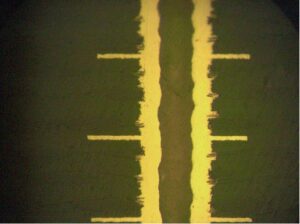
PCB cross-section analysis, also called microsection analysis, provides a magnified view of the internal construction of a PCB or test structure.
For plated interconnects, cross-sections can help examine copper plating, vias, dielectric layers, and other internal features.
When combined with D-coupon testing, cross-sectional analysis can help connect an electrical test result with a physical condition.
For example, if resistance changes during thermal cycling, a cross-section may help identify whether cracking, separation, voiding, or a plating-related issue contributed to the failure.
This makes microsection analysis an important complement to PCB reliability testing.
D-Coupon Testing vs. Plating Thickness Testing
D-coupon testing and copper plating thickness measurements provide different types of information.
Plating thickness testing asks:
Did enough copper get deposited?
D-coupon testing asks:
Does the plated interconnect maintain its electrical integrity after thermal stress?
Neither replaces the other.
Plating thickness verification, microsection analysis, D-coupon testing, and manufacturing process controls each provide a different perspective on PCB plating reliability and interconnect performance.
Together, they provide a more comprehensive approach to evaluating plated structures.
Why Interconnect Reliability Matters for HDI and Multilayer PCBs
As PCB designs become more complex, the reliability of individual interconnects becomes increasingly important.
HDI PCBs rely on microvias and other fine-pitch structures to create high-density connections between layers. High-layer-count multilayer PCBs also depend on reliable plated through-holes and vias to maintain electrical continuity throughout the board.
For these designs, evaluating how interconnects perform under thermal stress can provide valuable reliability information.
D-Coupon Testing for High-Reliability Electronics
D-coupon testing can be particularly relevant for demanding applications where PCB reliability is critical, including:
- Aerospace
- Defense
- Medical
- Automotive
- Semiconductor testing
- Other high-performance electronics
The appropriate testing methodology depends on the PCB design, application, specifications, and customer requirements.
D-Coupon Testing in U.S. PCB Manufacturing
For domestic electronics manufacturers, selecting a U.S. PCB manufacturer with the engineering, fabrication, inspection, and testing capabilities to support complex designs can be an important part of a reliable supply chain.
Gorilla Circuits is a Silicon Valley-based PCB manufacturer providing PCB fabrication and assembly from its San Jose, California operations. Our capabilities support complex multilayer and HDI designs, with reliability-focused processes including inspection, testing, microsection analysis, and plating verification.
Our approach combines manufacturing expertise with engineering and quality processes to evaluate critical PCB structures throughout fabrication.
Looking Beyond Dimensional Compliance
PCB reliability involves more than confirming that a finished board meets its dimensional requirements.
For plated through-holes, vias, and microvias, how an interconnect performs under thermal stress matters as well.
D-coupon testing provides another layer of verification by evaluating electrical performance after thermal exposure, while cross-section analysis can provide a closer look at the physical structure.
For engineers designing demanding electronics, that additional insight can be valuable when evaluating PCB reliability, plated interconnect performance, and long-term product requirements.
Gorilla Circuits | Silicon Valley-Based USA PCB Manufacturing, Fabrication & Assembly
Blog by Casey Willard, Marketing Manager