


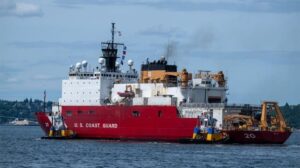
This summer, the U.S. Coast Guard Cutter Healy departed Seattle for a critical 2025 Arctic deployment. Among the missions on board advanced research led by the Woods Hole Oceanographic Institution (WHOI), in collaboration with the Office of Naval Research (ONR) and the National Science Foundation (NSF).
We’re proud to share that Gorilla Circuits PCBs are being used in key systems supporting this mission.
Enabling Next-Generation Arctic Research
WHOI’s first mission aboard Healy involves deploying and servicing instruments for the Arctic Mobile Observing System (AMOS). This initiative, led by the ONR, is developing autonomous, mobile platforms that study sea ice dynamics and improve understanding of Arctic water circulation.
AMOS’s aim is to build a scalable, long-term monitoring system that can persist in ice-covered regions with minimal human intervention. That requires rugged, high-performance electronics built to survive harsh conditions.
In the second mission, WHOI will recover, service, and redeploy long-term subsurface mooring arrays as part of the Nansen and Amundsen Basins Observational System (NABOS). This is an NSF-supported effort to monitor oceanographic conditions deep beneath the Arctic surface.
Both of these missions rely on electronics that perform reliably in extreme pressure, cold, and isolation. This is an ideal challenge for our high-quality, U.S.-made circuit boards.
Built to Perform. Anywhere on Earth.
From design to production, our boards are manufactured entirely in San Jose, CA, with full in-house control over PCB fabrication and assembly. That means tighter quality, faster turnarounds, and the ability to support critical, high-performance applications in sectors ranging from aerospace and defense to oceanographic science.
Gorilla is honored to be part of this historic deployment. We are excited to see how the research unfolds in the coming months.
Blog Post by Casey Willard
The image of the USCG’s Healy is from the article here.